Introduction
Securities are fundamental instruments in finance and investment. They provide a structured way for governments, corporations, and institutions to raise capital, while offering investors opportunities to earn income, build wealth, and manage risk. Securities markets also support economic growth by efficiently allocating financial resources.
This article provides a comprehensive and educative explanation of securities, including their meaning, major types, characteristics, functions, risks, and importance in the global financial system.
What Are Securities?
A security is a tradable financial instrument that represents ownership, a debt obligation, or a legal right to financial value. Securities are issued by governments, companies, and financial institutions to raise funds for business operations, infrastructure projects, and expansion.
When an investor purchases a security, they are either:
Owning a share of an organization
Lending money to an issuer
Holding rights linked to the performance of an underlying asset
Securities are bought and sold in regulated financial markets such as stock exchanges and over-the-counter markets.
Key Characteristics of Securities
Securities share several defining features that make them suitable for trading and investment.
Tradability
Most securities can be easily transferred between investors in financial markets.
Financial Value
Securities have measurable monetary value and may generate income through dividends, interest, or capital gains.
Legal Rights
Each security grants specific legal rights, including voting rights, interest payments, or claims on assets.
Standardization
Securities are issued in standardized units, which promotes transparency and market efficiency.
Regulation
Securities markets are regulated to protect investors and ensure fair trading practices.
Main Types of Securities
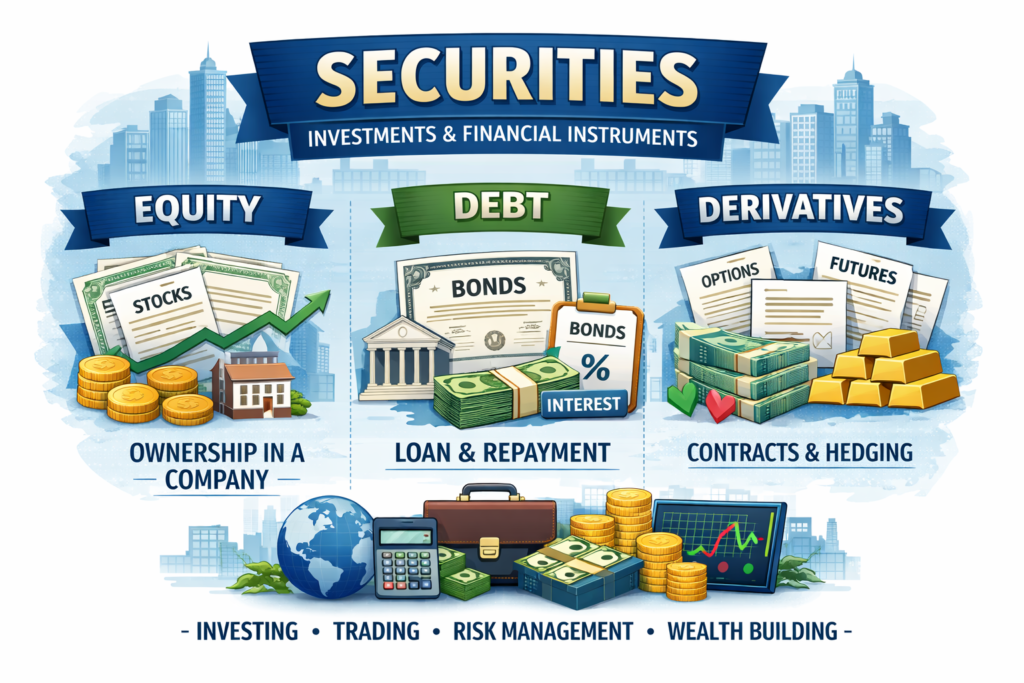
Securities are broadly classified into equity securities, debt securities, and derivative securities. Each category has distinct features, risks, and returns.
Equity Securities
Equity securities represent ownership in a company. Investors who hold equity securities participate in the company’s profits and growth.
Common Stock
Common stock is the most widely traded equity security. Holders of common stock:
Own part of the company
Have voting rights in corporate matters
May receive dividends
Benefit from increases in share price
However, common stock carries higher risk because returns depend on company performance and market conditions.
Preferred Stock
Preferred stock is a hybrid security with characteristics of both equity and debt. Preferred shareholders:
Receive fixed dividend payments
Have priority over common shareholders in dividend distribution
Usually do not have voting rights
Preferred stock generally offers lower risk and more stable income than common stock.
Debt Securities
Debt securities represent borrowed funds that must be repaid with interest. Investors who buy debt securities act as lenders to the issuer.
Bonds
Bonds are long-term debt securities issued by governments, corporations, and public institutions. Bonds typically include:
A fixed principal amount
Regular interest payments
A maturity date
Government bonds are considered relatively low risk, while corporate bonds offer higher returns with increased risk.
Treasury Bills and Notes
Treasury securities are issued by governments to finance public expenditure:
Treasury bills are short-term instruments
Treasury notes and bonds are medium- to long-term instruments
These securities are often viewed as safe investment options.
Debentures
Debentures are unsecured debt securities backed by the issuer’s creditworthiness rather than physical assets.
Derivative Securities
Derivative securities derive their value from underlying assets such as stocks, bonds, commodities, currencies, or interest rates.
Common Types of Derivatives
Options give the holder the right, but not the obligation, to buy or sell an asset at a specified price
Futures are contracts to buy or sell an asset at a future date and price
Swaps involve exchanging financial obligations or cash flows
Derivatives are commonly used for hedging, risk management, and speculation.
Hybrid and Alternative Securities
Some securities combine features of different categories to provide flexibility and diversification. Examples include:
Convertible bonds
Exchange-traded funds
Asset-backed securities
These instruments allow investors to manage risk while pursuing returns.
Primary and Secondary Markets
Primary Market
The primary market is where new securities are issued for the first time. Examples include:
Initial public offerings
Government bond issuance
Private placements
Funds raised in the primary market go directly to the issuer.
Secondary Market
The secondary market allows investors to trade existing securities. Stock exchanges and electronic platforms provide liquidity and help determine market prices.
Importance of Securities in the Economy
Securities play a crucial role in economic development and financial stability.
Capital Formation
They enable businesses and governments to raise funds for investment and growth.
Wealth Creation
Securities provide individuals with opportunities to earn income and build long-term wealth.
Risk Distribution
Financial risk is spread among many investors rather than concentrated in a single entity.
Market Transparency
Regulated securities markets promote transparency, accountability, and investor confidence.
Economic Indicators
The performance of securities markets often reflects broader economic conditions.
Risks Associated With Securities
All securities involve risk. Common risks include:
Market risk
Credit risk
Liquidity risk
Interest rate risk
Inflation risk
Understanding these risks is essential for informed investment decisions.
Regulation of Securities Markets
Securities markets are regulated to protect investors and maintain orderly market operations. Regulation typically focuses on:
Disclosure requirements
Prevention of fraud and manipulation
Fair trading practices
Strong regulatory frameworks support market stability and investor confidence.
Conclusion
Securities are essential financial instruments that link investors with capital-seeking entities. Through stocks, bonds, and derivatives, securities support economic growth, wealth creation, and efficient financial markets.
Conclusion
Securities are essential financial instruments that link investors with capital-seeking entities. Through stocks, bonds, and derivatives, securities support economic growth, wealth creation, and efficient financial markets.