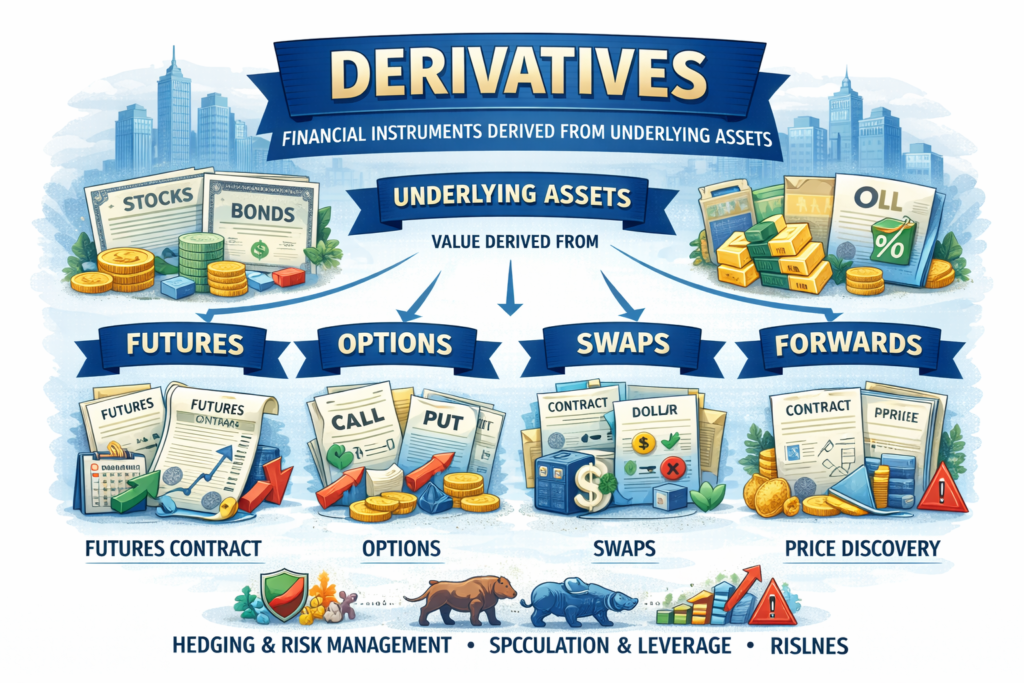
Derivatives are financial instruments whose value depends on the performance of another asset. They occupy a central position in modern financial markets because they allow individuals, businesses, and governments to deal with uncertainty about future prices. Although derivatives are often associated with speculation, their primary economic function is risk management.
The underlying asset from which a derivative derives its value may be a stock, bond, commodity, currency, interest rate, or market index. Changes in the price of the underlying asset directly affect the value of the derivative contract. For this reason, derivatives do not have independent value; they exist as financial agreements tied to something else.
Nature and Structure of Derivatives
A derivative is created through a contractual agreement between two or more parties. The contract specifies key elements such as the price, quantity, duration, and method of settlement. At maturity, the contract is settled either by physical delivery of the underlying asset or by cash settlement based on price differences.
Derivatives are described as zero-sum instruments because the gain of one party corresponds to the loss of another. This feature distinguishes derivatives from traditional investments like shares, where all participants may benefit if a company grows.
Types of Derivatives
Derivatives can be grouped into four main categories: futures, options, forwards, and swaps. Each category has distinct characteristics and economic purposes.
Futures Contracts
Futures contracts are standardized agreements to buy or sell an underlying asset at a predetermined price on a specified future date. They are traded on organized exchanges and follow strict rules regarding contract size, expiration dates, and settlement procedures.
Futures contracts require participants to deposit a margin, which acts as a financial guarantee. Prices are adjusted daily to reflect market movements. Futures are commonly used in commodity markets, currency markets, stock index trading, and interest rate management. They help producers, consumers, and investors manage price volatility.
Options Contracts
Options are derivatives that give the buyer the right, but not the obligation, to buy or sell an underlying asset at a specific price within a defined period. The buyer pays a premium for this right. The seller, known as the writer, is obligated to fulfill the contract if the buyer exercises the option.
There are two main types of options. Call options provide the right to buy, while put options provide the right to sell. Options are widely used to manage downside risk, generate income, and take advantage of price movements without committing to full ownership of the underlying asset.
Forward Contracts
Forward contracts are agreements between two parties to buy or sell an asset at a future date for a price agreed upon today. Unlike futures, forward contracts are not standardized and are traded privately between parties. This flexibility allows contracts to be tailored to specific needs, but it also increases the risk that one party may fail to meet its obligations.
Forwards are commonly used in foreign exchange transactions and commodity trading, particularly where customized contract terms are required.
Swaps
Swaps are derivative contracts in which two parties agree to exchange cash flows over a specified period. The most common swaps involve interest rates and currencies. In an interest rate swap, one party may exchange fixed interest payments for floating interest payments. Currency swaps involve exchanging cash flows in different currencies.
Swaps are mainly used by corporations and financial institutions to manage long-term exposure to interest rate and currency fluctuations.
Economic Purpose of Derivatives
The most important economic function of derivatives is risk management. Businesses face uncertainty from changes in prices, interest rates, and exchange rates. Derivatives allow them to transfer this risk to parties willing to assume it.
Derivatives also play a role in speculation, where investors seek to profit from price movements. Because derivatives often involve leverage, they allow traders to control large positions with relatively small amounts of capital. This feature increases both potential gains and potential losses.
Another key function of derivatives is price discovery. Derivatives markets reflect collective expectations about future prices, providing valuable information to producers, consumers, and investors.
Benefits of Derivatives
Derivatives contribute to financial market efficiency by improving liquidity and enabling better allocation of risk. They allow market participants to plan with greater certainty, stabilize cash flows, and reduce the impact of adverse price movements.
By linking future expectations with current prices, derivatives also enhance transparency and support informed decision-making across financial markets.
Risks Associated With Derivatives
Despite their usefulness, derivatives involve significant risks. Market risk arises from unfavorable price movements. Leverage risk occurs because small changes in price can produce large financial outcomes. Credit risk exists when one party fails to honor contractual obligations, particularly in over-the-counter contracts.
Liquidity risk may occur when a derivative cannot be easily sold or closed before maturity. Operational risk can result from errors in valuation, documentation, or settlement processes.
Understanding these risks is essential for anyone involved in derivative transactions.
Regulation and Market Stability
Derivatives markets are regulated to promote transparency and reduce systemic risk. Regulatory frameworks often require reporting, margin deposits, and central clearing of certain contracts. These measures help limit excessive risk-taking and protect the stability of the financial system.
Effective regulation ensures that derivatives continue to serve their economic purpose without undermining market confidence.
Conclusion
Derivatives are integral components of modern financial markets. They derive their value from underlying assets and function primarily as tools for managing uncertainty. Through futures, options, forwards, and swaps, derivatives enable risk transfer, support price discovery, and enhance market efficiency.
When properly understood and responsibly used, derivatives contribute to economic stability and financial development. Their significance lies not in speculation alone, but in their ability to help individuals, businesses, and institutions navigate an uncertain financial environment.