Introduction
In today’s financial world, managing risk and making informed investment decisions is crucial. One of the most effective tools for investors, traders, and businesses is the future contract. While it may sound complex, a future contract is simply a legal agreement to buy or sell an asset at a predetermined price on a specific date in the future. These contracts exist for commodities like oil and gold, as well as financial instruments like stock indices and currencies. Understanding future contracts is essential for anyone interested in futures trading, hedging, or financial markets.
What Are Futures Contracts?
A futures contract is a standardized agreement between two parties to exchange an underlying asset at a future date for a price agreed upon today. Unlike forwards, which are private agreements, future contracts are traded on regulated exchanges, ensuring transparency, security, and liquidity. Future contracts can be based on a variety of assets including commodities like crude oil and wheat, financial instruments like stock indices and bonds, currencies, interest rates, and even emerging assets like cryptocurrencies.
Features of Futures Contracts
Futures contracts have several important features. First, they are standardized, specifying the quantity, quality, and delivery terms of the underlying asset. For example, one crude oil futures contract on the NYMEX represents 1,000 barrels of oil. Second, they allow leverage, meaning traders can control large positions with a small initial deposit called a margin, which can amplify both profits and losses. Third, futures are marked-to-market, meaning accounts are adjusted daily to reflect gains and losses. Fourth, they have a fixed expiry date, when the contract is either delivered physically or settled in cash. Finally, future contracts are highly liquid, making it easy to enter or exit positions.
How Futures Contracts Work
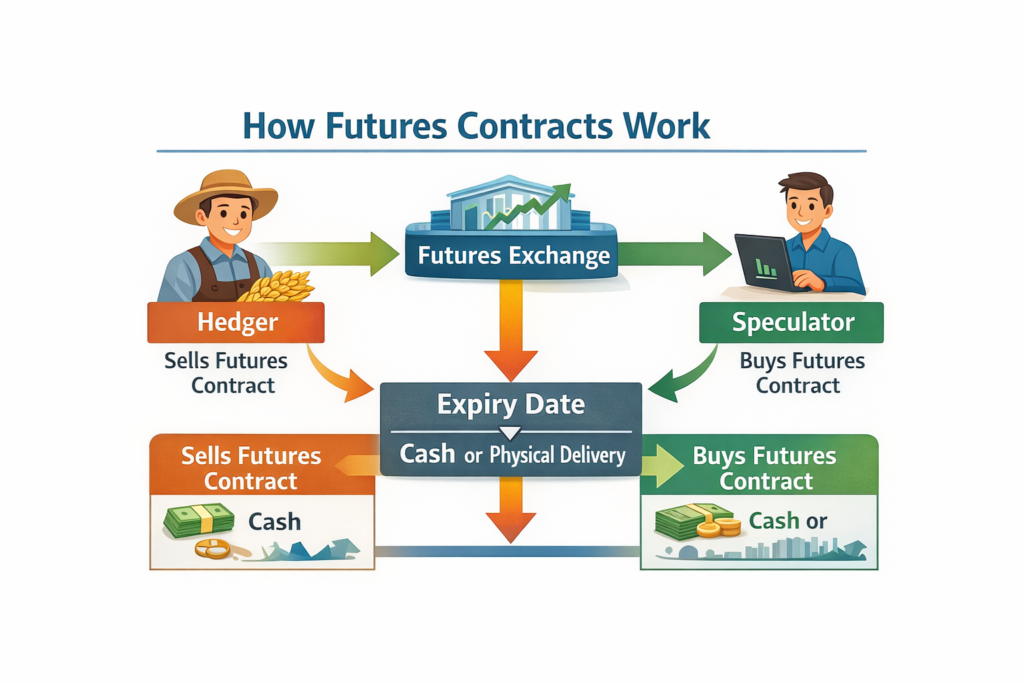
To illustrate, consider a farmer expecting to harvest 10,000 bushels of wheat in three months. Concerned that wheat prices may drop, the farmer sells future contracts to lock in the price. If the current wheat price is $5 per bushel and each futures contract covers 5,000 bushels, the farmer sells two contracts at $5 per bushel. Even if the market price drops to $4, the farmer is guaranteed $5 per bushel. This process is called hedging, a common use of futures to protect against price fluctuations. Conversely, a speculator might buy futures contracts expecting prices to rise. If wheat prices increase, the speculator profits; if prices fall, losses occur. Unlike hedgers, speculators do not intend to take delivery of the commodity.
Types of Future Contracts
Future contracts generally fall into two categories: commodity futures and financial futures. Commodity futures involve physical goods such as crude oil, gold, natural gas, wheat, or coffee. They are used by producers and consumers to manage price risks. For example, an airline may use fuel futures to hedge against rising costs. Financial futures are based on financial assets like stock indices, bonds, currencies, or interest rates. For instance, investors might buy S&P 500 futures to profit from rising stock prices or to hedge a portfolio against market downturns.
Benefits of Future Contracts
Future contracts offer several benefits. They are effective tools for risk management, allowing businesses and individuals to stabilize revenues and costs. They also provide speculation opportunities, enabling traders to profit from price movements without owning the underlying asset. Futures markets contribute to price discovery, helping market participants predict future prices for commodities or financial assets. Additionally, futures are highly liquid and accessible, allowing participants to quickly enter or exit positions.
Risks Involved in Futures Trading
Despite their advantages, future contracts carry risks. Leverage risk can amplify losses if the market moves against a trader. Market risk arises due to price fluctuations caused by economic events, geopolitical issues, or natural disasters. Liquidity risk may occur in niche markets with low trading volumes, making it hard to close positions. Lastly, while regulated exchanges mitigate most risks, there is a small counterparty risk.
Settlement of Futures Contracts
Future contracts can be settled in two ways: physical delivery or cash settlement. Physical delivery involves exchanging the actual asset, such as gold bars or oil barrels. Cash settlement involves paying or receiving the difference between the contract price and the market price at expiration. Most financial futures are cash-settled, while commodity futures can involve physical delivery.
Real World Applications of Futures Contracts
Future contracts are widely used in the real world. Businesses use them for hedging: farmers hedge crop prices, airlines hedge fuel costs, and exporters hedge currency risks. Traders use futures for speculation, profiting from market price movements without owning the underlying asset. Some also engage in arbitrage, taking advantage of price differences between spot and futures markets to earn risk-free profits.
Conclusion
Future contracts are powerful financial instruments that serve both risk management and investment purposes. They allow businesses to lock in prices, protect against volatility, and give traders opportunities to profit from price movements. While they carry risks, understanding the mechanics, types, and strategies of future contracts enables participants to make informed decisions in both commodity and financial markets. For anyone looking to explore futures trading, mastering future contracts is a key step toward success in financial markets.