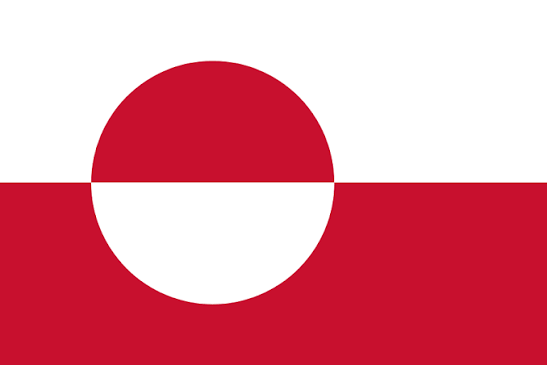
Greenland, known in the Greenlandic language as Kalaallit Nunaat meaning “the land of the Kalaallit,” is the world’s largest island. It lies between the Arctic and Atlantic Oceans and is geographically part of North America, though it has long-standing historical and political connections with Europe, particularly Scandinavia. Greenland’s history is shaped by Arctic survival, migration, exploration, and the interaction between indigenous cultures and European societies.
Human settlement in Greenland began around 2500 BCE when early Arctic peoples migrated from North America. Cultures such as the Saqqaq and Dorset developed survival strategies suited to extreme cold, relying on hunting seals, fish, and land animals with stone tools. Around the thirteenth century, the Thule people arrived from Alaska through northern Canada. They introduced advanced technologies including dog sleds, kayaks, and effective hunting tools. The Thule people are the direct ancestors of today’s Inuit population, whose culture and knowledge systems continue to shape Greenlandic society.
A major turning point in Greenland’s history occurred in the late tenth century with the arrival of the Norse explorer Erik the Red. Born in Norway and later settled in Iceland, Erik was exiled after a series of violent disputes. During his exile around 982 CE, he sailed westward and explored the southwestern coast of Greenland. After spending several years surveying the land, he returned to Iceland and deliberately named the territory “Greenland” to make it sound appealing and encourage settlement. His strategy proved successful.
Around 985 CE, Erik the Red led a fleet of settlers from Iceland to Greenland. These Norse settlers established two main colonies known as the Eastern Settlement and the Western Settlement. They practiced farming, raised livestock, hunted seals, and traded with Europe, especially in walrus ivory, which was highly valued in medieval markets. Erik the Red became the leading figure of these settlements and is remembered as the founder of Norse Greenland. His son, Leif Erikson, later sailed west and became the first known European to reach North America, centuries before Christopher Columbus.
Despite surviving for several centuries, the Norse settlements gradually declined and disappeared by the fifteenth century. Scholars suggest that climate cooling during the Little Ice Age reduced agricultural productivity, while isolation from European trade weakened the economy. Environmental degradation and difficulties adapting to Arctic hunting techniques may also have contributed to their collapse. The Inuit populations, who were better adapted to the changing climate, continued to thrive.
After the disappearance of the Norse settlements, Greenland remained largely isolated from Europe until the eighteenth century. In 1721, Danish-Norwegian missionary Hans Egede arrived in Greenland in an attempt to reestablish contact with the descendants of the Norse settlers. Instead, he encountered Inuit communities. His mission marked the beginning of renewed European presence and the start of long-term Danish colonial administration. Over time, Danish control reshaped Greenland’s governance, economy, and religious life.
In the twentieth century, Greenland entered a period of modernization and political change. In 1953, it became an official part of the Kingdom of Denmark, and Greenlanders were granted Danish citizenship. While this brought improvements in education, healthcare, and infrastructure, it also raised concerns about cultural assimilation. These tensions led to the introduction of Home Rule in 1979 and Self-Government in 2009, granting Greenland significant autonomy and recognizing Greenlanders as a distinct people with the right to determine their future.
Greenland’s geography remains central to its historical and contemporary development. The island covers over two million square kilometers, with more than eighty percent covered by ice. Human settlements are concentrated along the coast, where the climate is less severe and access to marine resources is possible. The Arctic environment shapes daily life through long winters, short summers, and natural phenomena such as the midnight sun and polar night. Today, the melting of the ice sheet due to climate change has placed Greenland at the center of global environmental research and concern.
The modern Greenlandic economy is heavily dependent on fishing, particularly shrimp and halibut, which form the majority of exports. Public services are supported by financial transfers from Denmark, while emerging industries such as mining and tourism offer potential for greater economic independence. Greenland’s mineral resources and strategic Arctic location have increased international interest in the region.
Culturally, Greenland is deeply rooted in Inuit traditions while also reflecting Scandinavian influence. The Greenlandic language is widely spoken and serves as a cornerstone of national identity. Traditional practices such as hunting, fishing, storytelling, and drum dancing remain important, alongside modern art, music, and literature that explore themes of nature, resilience, and identity. Communities are small and closely connected, with transportation relying mainly on sea and air routes.
Greenland today stands as a society shaped by ancient migration, Norse exploration, colonial rule, and modern self-government. The legacy of Erik the Red remains a defining chapter in its history, symbolizing both exploration and the limits of adaptation in the Arctic. As Greenland navigates climate change, economic development, and debates over independence, its history continues to inform its path into the future.